4-247 Vacant Home Tax
I support the ballot measure 4-247: City of Astoria Initiative - Vacant Home Tax (and the far less discussed Community Housing Fund). I signed the petition, I voiced support for it when we put it on the ballot at City Council. I think it moves us in a positive direction and, even if we need to defend it in court or change it in a future City Council, it is worth pursuing.
This is a long essay. I’ll address the parts of the discussion I can if you want specifics, but the bottom line is that I support this tax and housing fund to both discourage vacant housing and to create funds so we can incentivize more housing production. If it passes, I’ll do everything I can as Mayor to support it being a successful program.
Why do I support it?
Bringing down the cost of housing and doing our best to make sure every Astorian can afford housing has been a goal of mine since before I even joined the City Council. I ran on it 4 years ago, and I still believe it is a goal worth pursuing in Astoria.
While vacant homes may be a relatively small piece of the puzzle (my best estimate is somewhere between 200-300 homes might fit the definitions in the measure, or 4-5% of all our housing), I there’s no question in my mind that they have some impact on availability and cost of housing stock in town.
I’ll also say that beyond just the housing cost issue, I love Astoria in part because it is a place filled with people who live and work here year round. We still have a working waterfront. We still have significant business and industry in town. I don’t want it to turn into a coastal vacation town that is filled with empty houses half the year like many other coastal communities in Clatsop County. I also want younger generations to be able to afford to stay in town and continue family and community connections. If housing gets too expensive, only those who have really high income or access to unusual wealth will have that option.
Creating a disincentive for people to leave a house unused for most of the year is absolutely a good idea in my mind.
The housing cost picture in Astoria
Housing in Astoria is expensive. Expensive enough that it is a substantial barrier for most people to ever buy a house unless something changes or they have significant help.
Fully half of all renters are cost-burdened (paying more than 30% of their income on housing costs).
Median home sale price is currently around $480,000, while median income is $69,000. Monthly takehome for $69k in Oregon is around $4200. A monthly mortgage payment if you put 20% down (ha!) on a $480,000 house here would be $2300. That’s 55% for the median house on the median income. That is not reachable.
We’ve made some progress building housing in Astoria, and national economic trends are hitting housing prices broadly, but we’ve still got a substantial disconnect between housing costs and incomes in the area. The national trends are mostly hitting housing because cost of living and interest are rising dramatically enough that buying homes is even more of a lift for people than normal, and not because we are overproducing housing supply or something.
Housing Supply
From my perspective, the most reliable solution to the housing cost issue is creating a surplus of housing. More housing on the market means competition to try and find a buyer or renter, and will drive housing costs down. It is difficult to make that much housing in Astoria mostly because of geography (very little available land, slide risks, steep topography, etc.), but there are other challenges too. Permitting, cost of materials, availability of construction workforce, and sometimes expense to connect to infrastructure are all significant challenges here.
City Council has been working with staff to prioritize code and permitting improvements to streamline the process and at least ease that part of the picture. There are a set of improvements moving through now, and our workplan calls for more significant changes coming through next year.
But most of the other challenges are going to be difficult. We can support local construction trades education. We can try to lobby Salem to approve us expanding the urban growth boundary for the city. We could subsidize the infrastructure and permitting costs. Those can all be helpful and are all things we’ve worked on or discussed the current feasibility of.
The quickest way to create more available housing is to move housing that is already here from non-use into use. If there is a vacant house that can be on the market, we should encourage it to be put in use.
What about just building a stronger local economy?
One of the comments that comes up frequently is something like “we just need to attract/grow more business so that people have better paying jobs and can afford the housing.”
I totally a) understand the appeal of that line of thought and b) think that the city should be trying to build and encourage more successful businesses in town. Rising incomes would 100% help, and I totally agree with folks who think that tourism cannot be the only foundation of the local economy. Bringing in high-wage jobs is important, no doubt about that.
But I’ll also bring back this from a couple of sections ago:
Median home sale price is currently around $480,000, while median income is $69,000. Monthly takehome for $69k in Oregon is around $4200. A monthly mortgage payment if you put 20% down (ha!) on a $480,000 house here would be $2300. That’s 55% for the median house on the median income. That is not reachable.
To afford the payment on the median-cost new home here at 30% of your income ($2300/mo), your household needs to make $135k gross income annually. There are a small handful of cities with over 10k people in Oregon that make anywhere near that kind of income (all Portland suburbs).
The highest county median income in Oregon is $108k in Washington County. That is to say: 22,000 jobs from a global tech giant like Intel couldn’t even get Washington County to the level where their median income resident wouldn’t be cost-burdened by our current housing costs.
I don’t think we can grow our economy fast enough to outrun our housing costs without simultaneously making a ton of progress in bringing those costs down.
How does 4-247 make any appreciable difference when it is only a small number of homes?
First, let me say that I agree: the vacancy tax is a small part of the big picture. To make the kind of price changes I’d like to see will take more than the 200-300 homes I think might be impacted by this plan.
But I think it is important to see this as part of a bigger, and long-term picture. Let me repeat that the quickest way to create more available housing is to move housing that is already here from non-use into use.
There are, broadly speaking, probably three main competing uses for long term housing stock that would prevent its use as permanent housing. 1) Second homes/seasonal use, 2) Short term rentals, 3) abandonment.
Astoria has laws on the books to limit the impact of #2 and #3. I don’t have any real concern that either will take up too much housing stock long term with the laws already in place.
But second homes and seasonal use are perfectly legal and not practically limited in Astoria. Every home that is bought and used for only temporary inhabitation means one less home on the market for a permanent resident to possibly use. Here’s what the housing stock in Astoria looks like now:
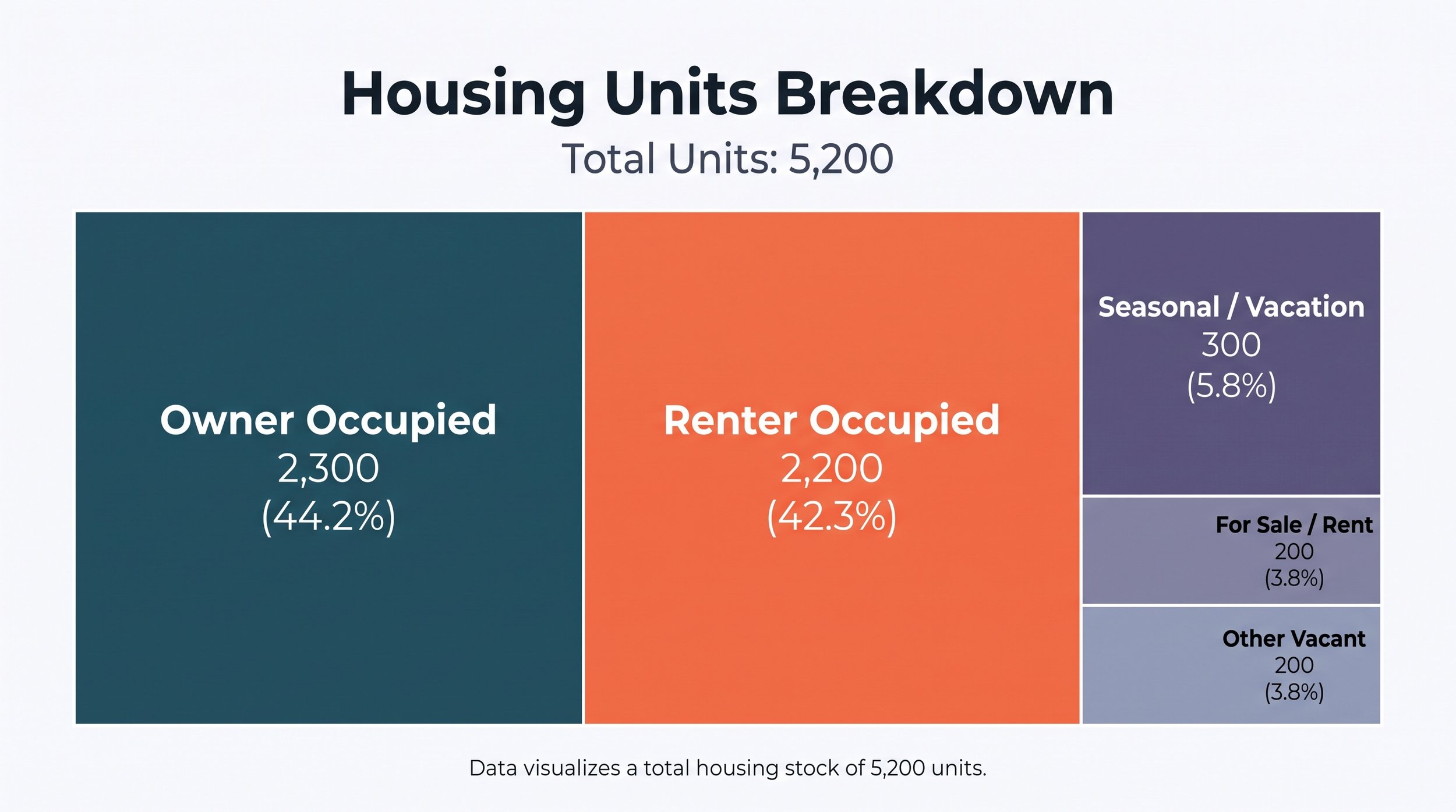
I’m rounding numbers a bit because all of this is based on numbers from the Census with a huge margin of error anyway, but I’m not trying to distort anything, just make it simpler.
Even if we are talking about 200 units, it could make a significant difference in pricing to have them circulating in the market. Even the last few months, more units being available for sale has been part of prices starting to plateau and dip in Astoria. Of course finance and general economy factors in, but 200 homes is a big deal.
But what happens if they don’t want to sell their place? Well, I guess they pay the tax.
The Community Housing Fund
I’ll quote the measure notice here:
“Revenue is deposited in a locally controlled Community Housing Fund and may be used only for affordable or workforce housing, housing assistance, tenant services, and administration and enforcement of the tax.”
Personally, I would have preferred they only use the funds for building housing and administration and I’d lobby to change that if it ever hit City Council. But we can cross that bridge when we come to it.
Let’s say that there are 200 houses being used in a way that would make them liable for this tax. Let’s further say that half of them say ‘to hell with Astoria, I’m selling and moving!’ or maybe more positively they say ‘oh, fine, let’s finally just move to Astoria full time because we love the place.’
Either way, say 100 people sell, move or rent their place. That’s great! 100 more houses being used for long term housing! 100 more neighbors living in housing.
Then the 100 remaining houses would be liable for a $3000 year-one tax and then a $6000 tax in later years. That’s $300,000 in revenue in year 1, $600,000 in year two. A city employee to run the program may cost $100,000 total (again, rounding for simplicity).
We’re talking about $500,000 net revenue for the city each year if the stock of vacant homes stays the same. With some amount of matching from state/federal housing programs, it isn’t hard to imagine that being leveraged to build 5 new housing units a year (using a private developer who the city pays a $100,000 per unit subsidy for apartments or townhomes).
5 units a year, plus 100 units quickly returning to the market is a huge win if you want to see more housing and for housing prices to come down because of supply pressure.
What about people who have planned for this use for years?
This is probably an area where I’m not in total alignment with the petitioners who put the measure together. I think this would seem more fair and would have been safer to pass into law if it grandfathered in existing use.
But the counter-case is in the section above: that half of the program is using tax revenue to help make housing more affordable. If you have to wait years for a trickle of new houses to be eligible, maybe it isn’t useful as a program. I get that too.
Personally, I think this is one area where I could see having a program that is grandfathered in where the main focus is limiting the proliferation of vacant/vacation/second homes, and any revenue is just a bonus. But that’s not what will come to the ballot.
But what about legal challenges?
Again, totally valid question. It probably will get challenged if it passes. For this section, it is important to say I’m not a lawyer.
My reading of parallel cases makes me believe that there isn’t a clean precedent that would apply directly here. Many cases involve application of state laws that Oregon does not have. But also, Oregon has strong constitutional limits around anything that can be construed as a property tax that aren’t always applicable to other cases.
The petitioners tried to make clear by language that they consider this an excise tax, and not a property tax. That it is based on use, not on ownership. I don’t know if the courts will agree with that framing within the measure, and it might be struck down on that basis or it might be allowed to stand.
Based on other cases, it seems that there’s also a reasonable risk of a claim under the Takings Clause of the 5th amendment, that the measure would deprive someone of a current interest or value in their property. So in a regulatory taking, the court might rule that a regulation went too far and the government would need to either compensate the property owner or give up the regulation.
Usually we get around this in local code by grandfathering in current uses of a property. But Takings cases don’t seem to have a binary test that is easily predicted, so perhaps a legal challenge is worth fighting. The petitioners seem to have considered this and decided it was an acceptable risk after legal consultation.
I would not be surprised if, should the measure pass, it ends up being overturned in court. But I’m also not entirely sure that it couldn’t be salvaged, depending on the actual ruling of the court. Perhaps we need to grandfather the thing. Perhaps it can be made into a fee. Again, I’m not a lawyer.
But I would say that a possible legal challenge alone doesn’t make me think this is unworthy of support. If the public shows a desire to limit the impact of vacant homes in the community and this particular measure is passed but struck down in court, then I think it is justifiable for Council to pursue the same goal (limiting vacant homes, creating funding for building or supporting housing) by other legal means.
4-244 (Council Size):
I’ve given relatively long explanations for why I think this is a good idea at some of our Council meetings and work sessions, but I’ll lay out my case again here. Here are some main themes:
Every Councilor I’ve worked with or seen at the dais has brought value to the group. Even the Councilors I’ve disagreed with bring unique experiences and skill sets to the table. Including two more voices increases the odds that we will have ideas and perspectives that will add value to our work.
Opening up more Council positions allows opportunity for more pathways to service on the Council. Many elections for Council have had only one or two candidates on the ballot, but there have also been several in recent memory where three or more candidates ran. I also know from many years of working in local politics that even when there are two people on the ballot, often more people are interested in serving but just don’t want to run against the current candidates for a variety of reasons. Adding additional seats allows for more opportunity for service.
The motivations for at-large representatives and ward/district representatives are different. Supporters of Ward based representation prefer the close relationship possible with a ward representative, as well as the relatively higher value of an individual vote. I get that desire. My personal preference is for policy decisions to be biased toward creating the most public and private good, and I tend to think that focus on narrowly local concerns doesn’t move us in that direction.
For me, I think this year’s mayor race is a prime example. I have no doubt that each of the four candidates would bring value to the Council, each in unique ways. As a community we are wasting the opportunity to have more people put in good work for the community on City Council.
Ballot measures
Ballot measures
There are five ballot measures available to Astoria voters this election. I’ll write up individual pieces on all of them, but at high level, this is what I think of them and how I’ll be voting:
There are five ballot measures available to Astoria voters this election. I’ll write up individual pieces on all of them, but at high level, this is what I think of them and how I’ll be voting:
Measure 4-244 City of Astoria Charter Amendment - Council Size
YES. I’ll vote to support this amendment that adds 2 at-large City Council positions and brings Astoria’s Council size to 7 total from the current 5.
Measure 4-245 City of Astoria Charter Amendment - Mayor's Appointments
YES. I’ll vote to support this amendment that adds an “advice and consent” function to City Council on Mayoral appointments to and removals from city boards and commissions. Currently the Mayor has sole authority to appoint and remove board and commission members.
Measure 4-246 City of Astoria Charter Amendment - Update Charter
YES. I’ll vote to support this amendment that brings Astoria Charter language into alignment with recommended language in the League of Oregon Cities model charter and amends the Council process for filling Council vacancies.
Measure 4-247 City of Astoria Initiative - Vacant Home Tax
YES. I’ll vote to support this amendment to add a Vacancy Tax in the city of Astoria and allocate the collected funds to a Community Housing Fund.
Measure 4-249 Clatsop Care Center Health District Bond
YES. I’ll vote to support the issuance of a $34 million dollar bond to pay for the replacement of their current (100-year old) skilled nursing facility and to consolidate their operations to their complex on the South Slope of Astoria.